
1win Bet App Login Registration Download: Security Guide
- October 2, 2026
- Uncategorized
1win Bet App Login Registration Download: A Practical Guide Why the 1win Bet App Stands Out in a Crowded Market The 1win... Read More
 by meh.riztech
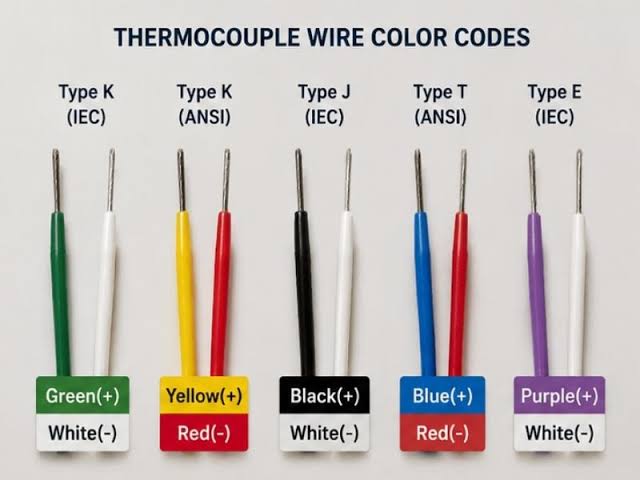
Thermocouples are among the most widely used temperature sensors in industrial equipment, laboratories, HVAC systems, furnaces, and manufacturing processes. But the sensor itself is only part of the measurement system. The wire connecting the thermocouple to an instrument can significantly affect accuracy, reliability, and long-term performance. Choosing the wrong thermocouple wire can introduce measurement errors even when the thermocouple probe is properly manufactured.
The challenge is that thermocouple wire is not simply ordinary electrical wire. Its conductors are made from specific metal combinations that generate a measurable voltage in response to temperature differences. The wire must therefore match the thermocouple type and application. Temperature range, insulation, environment, polarity, and installation distance all deserve consideration before making a selection.
Thermocouple wire is a pair of dissimilar metal conductors used to transmit the thermoelectric signal produced by a thermocouple. When the two metals experience a temperature difference between their measuring junction and reference junction, they generate a small voltage. The measuring instrument interprets this voltage as temperature.
Common thermocouple types include Type K, Type J, Type T, and Type E, with each using a different combination of metals and having different operating characteristics.
For example, Type K uses nickel-chromium and nickel-aluminum alloys and is commonly selected for industrial applications because of its broad temperature capability. Type J uses iron and constantan and is frequently found in older industrial equipment. Type T, made from copper and constantan, is useful for relatively low-temperature applications and is often used in laboratory or refrigeration environments.
The wire connecting the thermocouple to the measuring instrument must maintain the correct thermoelectric characteristics. Using unrelated copper wire for the entire connection can create additional junctions and unwanted voltage effects.
Choosing the right wire becomes much easier when the application is evaluated systematically.
Start by determining the thermocouple type used by the sensor and temperature controller.
A Type K thermocouple should normally be connected with Type K extension or thermocouple-grade wire. A Type J sensor requires compatible Type J wire, and so forth.
Do not assume that wires that look identical are interchangeable. Their electrical and thermoelectric properties can differ substantially.
Next, establish the temperature that the cable will actually encounter.
The sensing junction may be exposed to 1,000°F while the connecting cable remains in an area only a few hundred degrees Fahrenheit. In this situation, the insulation specification should be based on the environment around the cable rather than simply the maximum temperature at the sensing point.
For high-temperature installations, mineral-insulated cable, fiberglass insulation, ceramic materials, or other specialized constructions may be appropriate. For moderate environments, PVC or other polymer insulation may be sufficient.
Temperature is only one environmental factor.
Consider exposure to:
For example, a cable installed beside a motor may experience vibration and electromagnetic interference that would not exist in a laboratory. A cable running through a washdown area may require substantially different insulation and protection.
Wire gauge affects mechanical strength, resistance, response characteristics, and installation requirements.
Thicker conductors can be mechanically robust and useful for longer or demanding installations, while smaller conductors can be easier to route through restricted spaces. However, the smallest possible wire is not automatically the best choice.
The required gauge should be selected according to the manufacturer’s specifications, installation distance, mechanical conditions, and measurement requirements.
Thermocouple wires have positive and negative conductors. Connecting them backward can cause the measured temperature to move in the wrong direction as the sensing junction changes temperature.
Wire colors help with identification, but color conventions can vary between standards and manufacturers. When working on existing equipment, verify the applicable wiring standard and documentation rather than relying exclusively on memory.
One important distinction is between thermocouple-grade wire and extension-grade wire.
Thermocouple-grade conductors are generally manufactured from the same thermoelectric materials used in the corresponding thermocouple. Extension wire is designed for connecting a thermocouple over a specified temperature range and may use different but thermoelectrically matched materials.
This distinction matters because extension wire is not necessarily intended for the same temperatures as thermocouple-grade material.
For example, installing an extension cable in a hot section of equipment beyond its specified range can produce inaccurate measurements or premature insulation failure.
When selecting cable, check the manufacturer’s temperature rating and whether the product is intended for thermocouple or extension service.
Several wiring mistakes repeatedly cause temperature measurement problems.
Connecting a Type K probe to Type J wiring can create measurement errors because the conductors do not have the same thermoelectric characteristics.
Ordinary copper wire may seem convenient because it is inexpensive and readily available. However, inserting copper into a thermocouple circuit creates additional metal junctions that can alter the measured voltage.
A cable may have excellent electrical properties but still fail because its insulation cannot withstand the surrounding temperature, chemicals, or mechanical conditions.
Always evaluate the complete cable construction rather than looking only at conductor material.
Every connection introduces another potential failure point. Loose terminals, poorly crimped connections, moisture ingress, and incompatible connectors can all affect signal integrity.
Thermocouple signals are small, making them vulnerable to electrical noise. Routing the cable alongside high-power motor, inverter, or heater wiring can sometimes introduce unstable or fluctuating readings.
For a dependable installation, keep the following practices in mind.
Use matched components. The thermocouple, wire, connectors, and measuring instrument should be compatible with the same thermocouple type and applicable standards.
Keep connections secure. Loose terminals can create intermittent readings that are difficult to diagnose. Periodic inspection is especially important in equipment exposed to vibration.
Protect the cable mechanically. Use conduit, flexible protection, strain relief, or other suitable methods where cables may rub against metal edges or moving components.
Separate thermocouple wiring from high-voltage circuits. Where practical, maintain physical separation from power cables and other sources of electromagnetic interference.
Avoid unnecessary cable extensions. Longer runs are sometimes unavoidable, but unnecessary length creates more opportunities for mechanical damage, interference, and connection problems.
Document installations. Label the thermocouple type and cable destination. This simple practice can save considerable troubleshooting time when equipment is serviced months or years later.
Investigate unstable readings systematically. If a temperature suddenly becomes erratic, inspect the sensor, cable, connectors, insulation, grounding arrangement, and instrument configuration rather than immediately replacing the thermocouple.
For example, if a furnace controller intermittently reports temperatures several hundred degrees higher than expected, the problem might be a damaged cable near the furnace door rather than a defective sensor. Looking at the entire measurement circuit often identifies the problem faster.
Thermocouple wire plays a critical role in maintaining accurate and reliable temperature measurements. The correct choice depends on more than the thermocouple type. Temperature range, insulation, environment, conductor size, installation method, polarity, and electrical interference all need to be considered.
The most practical approach is to begin with the thermocouple type, determine the actual conditions surrounding the cable, and then select a compatible wire construction with appropriate temperature and environmental ratings. Proper routing, secure connections, and routine inspection can further reduce measurement problems.
When thermocouple wiring is treated as an important part of the measurement system rather than simply an accessory, temperature-control equipment becomes easier to maintain and considerably less prone to mysterious readings.

Der Moment, in dem du dein Hochzeitskleid anziehst und den passenden Schleier aufsetzt, ist pure Magie. Plötzlich verwandelt sich das wunderschöne Kleid... Read More

Introduction to Represent Tracksuit The Represent Tracksuit is an appealing option Represent Tracksuit for fashion enthusiasts who want to combine everyday comfort... Read More

Join The Discussion